Demographic change in Switzerland, which currently has a population of 9.1 million, not only shapes the country as a whole, but also the social and economic development of its 26 cantons. The nationwide trend of a significant increase in the population aged 65 and older, a shrinking working-age population and a decline in the younger generation is well known and frequently discussed in the media.
But can this pattern of demographic change be automatically applied to Switzerland's 26 cantons, or are there differences in the dynamics of social change? As is well known, the cantons differ in terms of:
- language – the language and dialect vary from canton to canton, or even between regions or local areas;
- culture – cantons often have their own cultural values, traditions and customs;
- politics – each canton has its own government, its own parliament and its own constitution;
- economics – key industrial sectors and their dynamics vary from canton to canton;
- forms of settlement – there are urban and rural regions as well as mountainous cantons;
- religion – this has a varying influence on family and social life.
An analysis of the 26 cantons up to 2050 – based on the "low" 2025 scenario of the Federal Statistical Office (FSO), which assumes a persistently low birth rate (1.25 children per woman), only a moderate increase in life expectancy (to 86.5 years for women and 82.5 years for men) and low net migration (30,000 per year) – reveals varying patterns of demographic change across the cantons. This pessimistic FSO scenario was deliberately chosen because
- an increase in the birth rate is not foreseeable;
- moderate immigration would in no way lead to social or infrastructural strain;
- productivity gains in the economy – which are necessary in any case – are an incentive that would bring about the mitigation of the foreseeable labor shortage; and
- the trend toward longer lifespans and the resulting aging of society is set to continue for the foreseeable future. The persistent challenges which face retirement provision and employment duration and models, and which make reform essential, are:
the resident population is growing – or shrinking
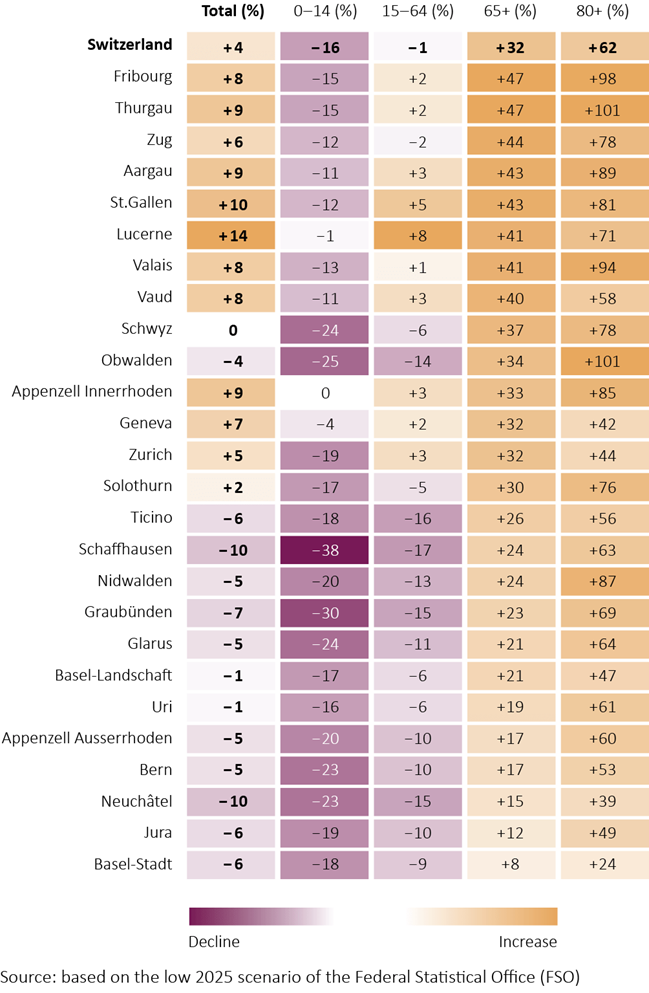
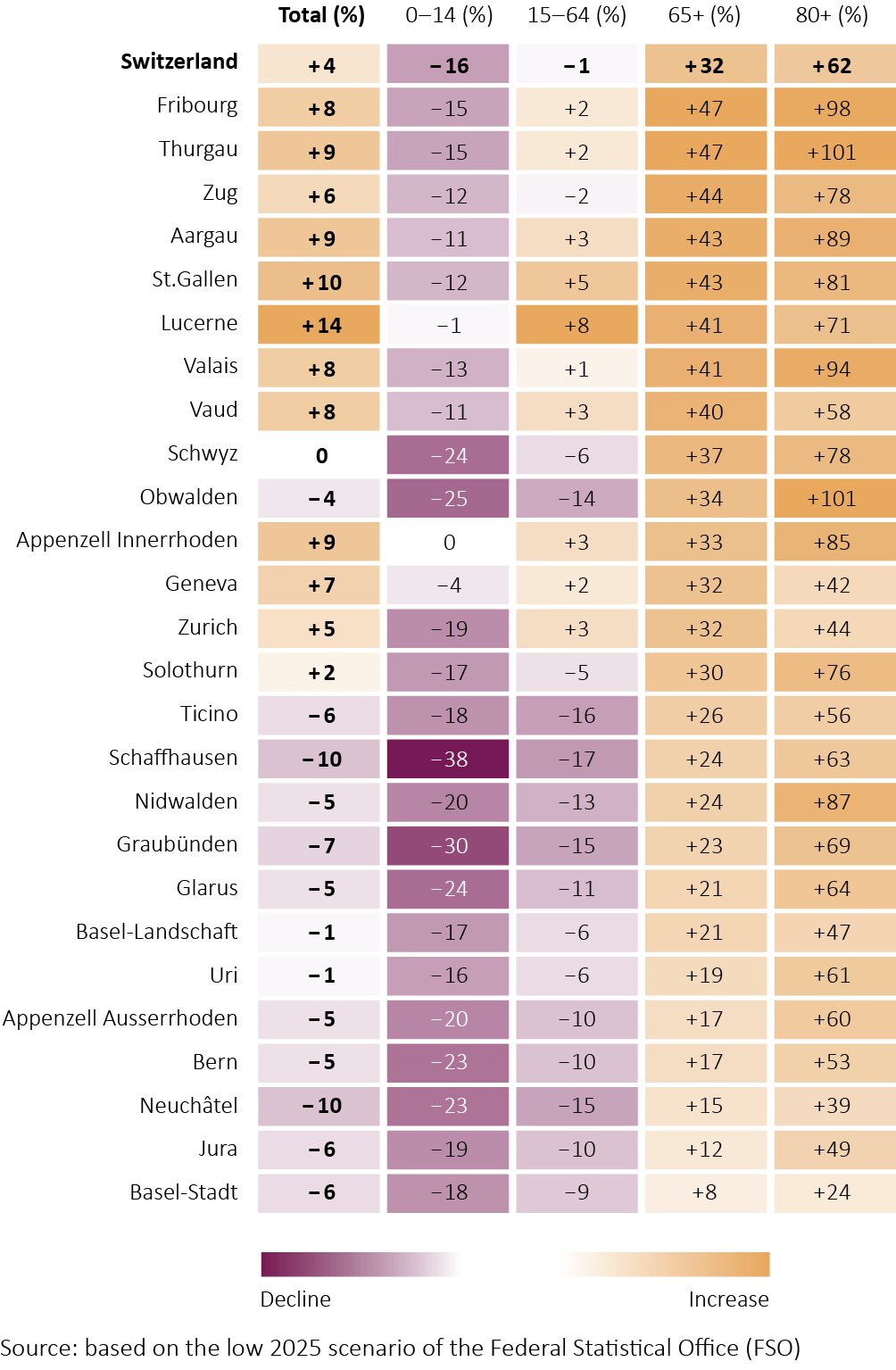
Across Switzerland, the population is still growing slightly. At the cantonal level, the picture is more nuanced: The population continues to grow in 12 cantons, while it is steadily declining in 14 cantons. The driving force behind population growth is always the working-age population. A decline, on the other hand, is driven by a combination of a shrinking working-age population and the 0-to-14 age group.
the number of children is declining nationwide
In all 26 cantons, the number of people in the 0-to-14 age group is declining, by around 15.5 percent across Switzerland. The hardest-hit regions are Schaffhausen (−38.4 percent), Graubünden (−30.4 percent) and Obwalden (−24.8 percent). Even in the fast-growing cantons of Geneva and Lucerne, the decline is noticeable (−4.3 percent and −1.3 percent, respectively).
the working-age population is shrinking in 17 of 26 cantons
Across Switzerland, the population of 15- to 64-year-olds is declining only slightly (−1.4 percent), but this figure masks significant variation: While the working-age population in Lucerne (+8.5 percent), St. Gallen (+5.1 percent), and Zurich and Vaud (+3 percent) is growing as a result of immigration, Schaffhausen (−16.9 percent), Ticino (−16.4 percent) and Neuchâtel (−14.9 percent) are experiencing massive declines in their working-age populations.
the number of OASI pensioners is continuing to grow by nearly one third
Across Switzerland, the number of people aged 65 and older is set to increase by 31.6 percent in absolute terms – from 1.88 million to 2.47 million. Their share of the population is rising from 20.8 to 26.5 percent – an increase of 5.7 percentage points. The increase in the aging population is particularly pronounced in Fribourg (+47.2 percent), Thurgau (+46.6 percent) and Zug (+43.7 percent) – cantons that are still relatively young demographically and that are experiencing the baby boom retirement effect with a delay.
and the over-80s are seeing the largest increase
While the population of people over 80 is growing by 57 percent nationwide, the number of people over 80 will double in several cantons – Thurgau and Obwalden both show a 101-percent increase, and Fribourg a 98-percent increase. Even in the most moderate case (Basel-Stadt, +24 percent), the proportion of people over 80 far exceeds the growth of the total population (+4 percent). The proportion of the population aged 80 and older is projected to rise nationwide from 6.5 percent (in 2025) to 10.2 percent (in 2050), reaching as high as 14.7 percent in Ticino and 14 percent in Nidwalden.
The elderly population has a significant impact on health and care costs: In Switzerland, per capita healthcare costs for people over 80 are about five times higher than those for people aged 50 to 64, and the proportion of people requiring care rises sharply after the age of 80. Cantons where the working-age population is shrinking – Ticino, Schaffhausen and Graubünden – must therefore finance and care for a doubling elderly population with fewer taxpayers and potentially fewer care workers.

Switzerland's demographics thus represent a multifaceted process of social change. Based on emerging demographic trends, the cantons can be classified into those experiencing exceptional, significant and minor changes in their resident population and demographic structure.
Identifying challenges through the "lens of demographics"
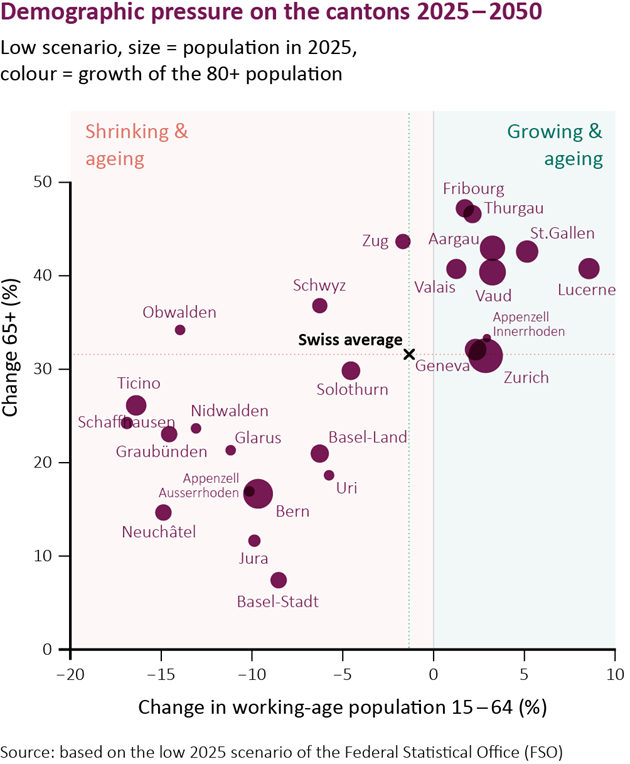
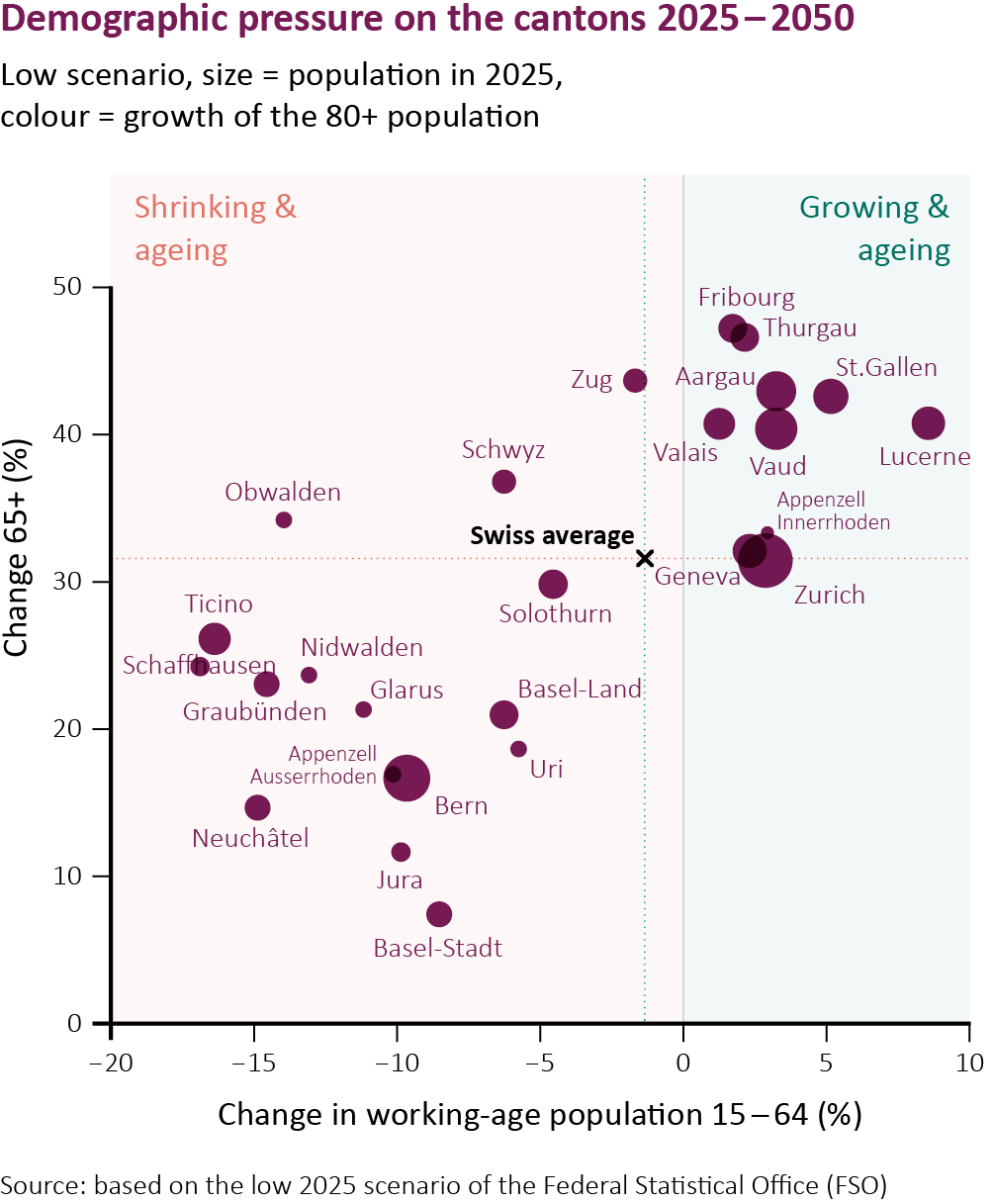
The extent of the "demographic pressure" on individual cantons over the next 25 years becomes apparent when considering changes in the working-age population relative to the population aged 65 and older.
Upper left quadrant: This shows cantons that are losing their working-age population and, at the same time, experiencing above-average population aging. Obwalden (−14 percent for 15- to 64-year-olds, +34 percent for those aged 65 and older) and Schwyz (−6 percent, +37 percent) clearly fall into this category. Zug also falls on the edge of this quadrant, with a 2-percent decline in the working-age population and a 44-percent increase in the 65+ age group – the third-fastest rate of aging among all cantons, accompanied by a slight decline in the working-age population. These cantons are under double pressure: a stagnant or shrinking working-age population must help finance and care for a rapidly growing number of older people.
Upper right quadrant: This quadrant includes cantons that are experiencing rapid population aging but are able to maintain or expand their working-age population thanks to immigration. Fribourg and Thurgau, for example, each see growth of about 47 percent in the 65+ age group, while the number of people aged 15 to 64 remains stable. Lucerne stands out with the strongest employment growth of all cantons (+8 percent), accompanied by a 41-percent increase in the number of retirees. Aargau (+43 percent) and St. Gallen (+43 percent) also fall into this quadrant.
Lower left quadrant: This group includes cantons that are losing their working-age population but that are aging at a slower-than-average rate, such as Ticino (−16 percent for those aged 15 to 64, +26 percent for those aged 65 and older), Schaffhausen (−17 percent, +24 percent), Neuchâtel (−15 percent, +15 percent) and Graubünden (−15 percent, +23 percent). Bern, as the second-largest canton, also falls into this category: The labor force is set to shrink by 10 percent, with a moderate aging rate of 17 percent. These cantons are rapidly losing their working-age population, and the old-age dependency ratio is still rising significantly. Basel-Stadt (+8 percent among those aged 65 and older, −9 percent among those aged 15 to 64) benefits from its location on the border and the flow of commuters from abroad, which partially offsets the decline. In most of these cantons, the old-age dependency ratio is projected to rise to more than 60 people of retirement age per 100 people in the labor force by 2050. Neuchâtel is the exception and, with an old-age dependency ratio of 46, will be close to the Swiss average (44).
Zurich and Geneva are close to the Swiss average: Zurich will see moderate labor force growth of 3 percent, with an aging rate of 32 percent; Geneva will experience 2-percent growth in the 15-to-64 age group, also with an aging rate of 32 percent − both figures are nearly identical to the national average. Solothurn too (+30 percent in the 65+ age group, −5 percent for 15- to 64-year-olds) lies close to the intersection of the reference lines.
The issues requiring answers and solutions:
- how does the living environment in a canton change when there is a fundamental shift in the population structure − fewer children, fewer working-age people and significantly more older and very elderly people?
- are the cantons capable of developing a demography-based vision − not as an abstract planning document, but as a concrete idea of how the respective canton will function in 20 years?
- how must infrastructure be adapted if the demand for school places declines, the need for care facilities increases, and hospitals have to care for a significantly older population?
- what (new) employment opportunities will emerge in an aging society, and how can labor markets be structured to remain attractive to both younger and older workers?
- how can cantons make themselves more attractive, particularly to younger people, in order to encourage migration into the region and slow the outflow of residents?
- which public and private services will be needed more often in the future, and which less so − and how can the transition be made without creating gaps?
- how do government agencies ensure that they can continue to meet their obligations, even as the number and the composition of taxpayers change and the number of benefit recipients increases?
- how can cantons and municipalities secure the necessary tax base in an environment where the working-age population is shrinking in 14 out of 26 cantons?
- and what does all this mean for personal life planning − for decisions about where to live, retirement provision, working in old age and one's own care needs?
The questions and their answers are challenging
Switzerland's demographics have cantonal characteristics and peculiarities − and it is important to understand these and to take them into account.
In light of these emerging developments, the next step must be a broad discussion across society, the business community and the political sphere − with the aim of initiating steps toward implementation.
With professional support from