Back to overview
Share article

The Switzerland of our future – Switzerland 2050

What can be expected in the next 25 years – and what should we focus on?
People have always been fascinated by what lies ahead: Their individual questions about the future are inextricably linked with a larger social context and demographic developments.
Switzerland 2050

Switzerland 2050: Concrete figures

Demographic changes can be reliably predicted. Their key parameters – life expectancy and birth rates – change only gradually over time. Accordingly, it is possible to predict with astonishing accuracy how Switzerland will develop up to 2050, including in comparison to the European or global environment.

The annual population growth of around 1 percent that has persisted since 1975 will slow down over the next 25 years. But even more importantly: The composition of the population in terms of age groups will undergo unprecedented shifts by 2050. While there used to be a large number of young people, the biggest population group is now middle-aged, and growing life expectancy means there are also significantly more elderly and very elderly people. A graphic showing age group distribution no longer looks like a "pyramid," but more like an "urn."

Assuming persistently low birth rates, a further increase in life expectancy and moderately persistent migration involving predominantly young, employable people, we can expect the following for Switzerland by 2050:

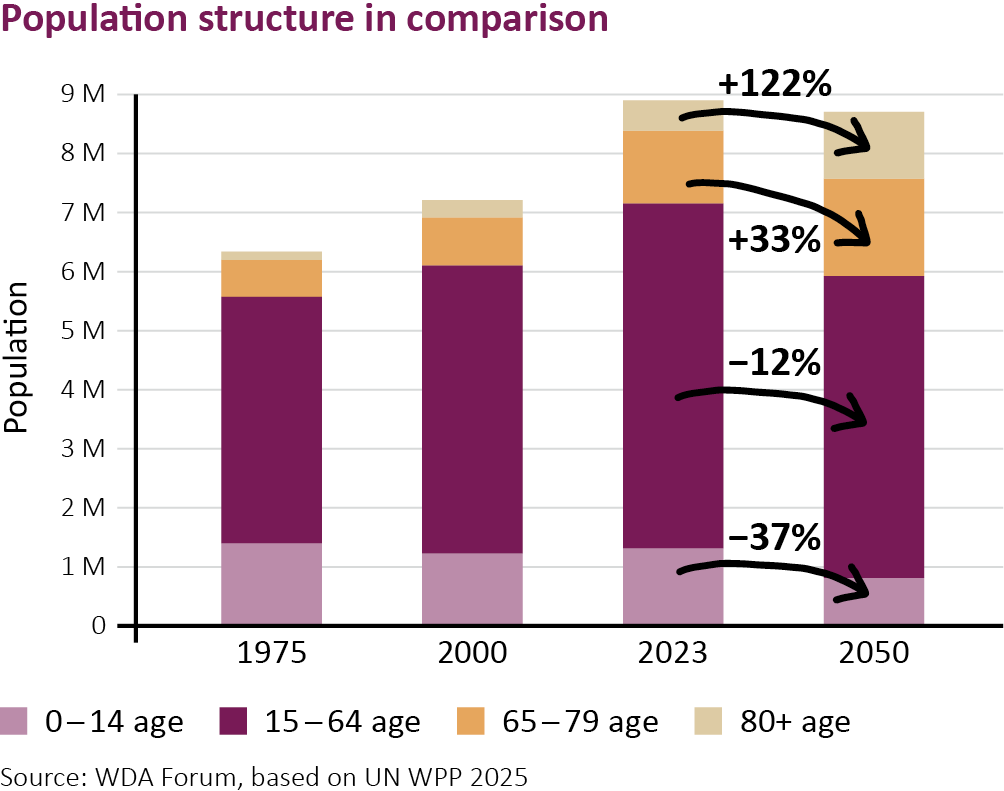
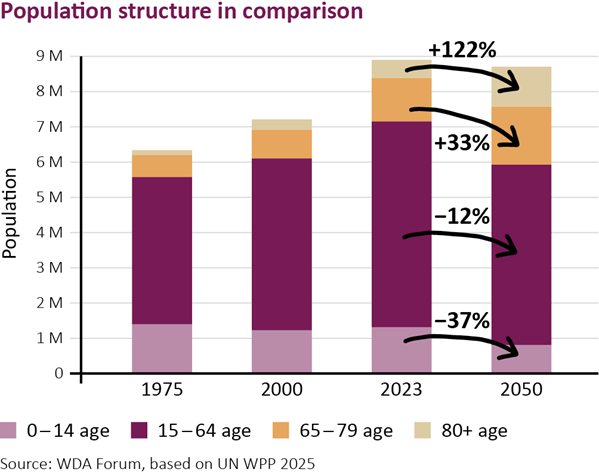
Population structure in comparison
  • The group comprising children (0 to 14 years of age) will decrease by 37 percent, or around 500,000! This corresponds almost to the population of the canton of Geneva.
  • The group comprising potentially employable persons (15 to 64 years of age) will decrease by 12 percent, or more than 700,000 – about four times the city of Bern.
  • The group comprising active pensioners (65 to 79 years of age) will increase by 33 percent, or 410,000 – equivalent to the city of Zurich.
  • The group comprising very old people (80+ years) will explode by 122 percent, or 620,000 – more than three times the city of Basel – with a massive impact on healthcare and nursing capacities.

Why turning a blind eye is not an option

These are demographic facts that many people ignore – intentionally or not. But fundamental questions arise:

  • Why can we not just wait and see?
  • What do we need to know?
  • How should we act and prepare?

From a pyramid to an urn

Our current supply systems and thus our social stability are based on rules that are sustainable and resilient under the conditions of a "population pyramid." But "many young people and few elderly ones" no longer corresponds with the Switzerland of 2050.

The future is a Switzerland with fewer and fewer young people and more and more people of an advanced age – a "population urn" in other words. Under these demographic conditions, we need to reshape our future – economically, socially and culturally.

Our shared challenges

In the next articles in the "The Switzerland of our future" series, we will be looking at the following topics:

  • Demographic change in Switzerland: The 26 cantons and their differences
  • Reshaping working life and the work environment
  • Increasing productivity despite a shrinking working population
  • Growing old in good health – preventive health strategies
  • A demographically compatible intergenerational contract
  • Innovative growth models in the economy
  • Sustainable wealth accumulation and wealth protection
  • Reliable and efficient public infrastructure

These challenges affect us all – as individuals, as a society and as companies. Together, we can develop solutions that make a prosperous and sustainable future possible for Switzerland.
About the author

Dr. med. Hans Groth, MBA, is Chairman of the Board of the World Demographic & Ageing Forum (WDA Forum), a think tank founded in St. Gallen in 2002. From 2009 to 2020, he was a guest lecturer at the University of St. Gallen (HSG) in Switzerland on the topic of "Megatrend: Global Demographic Change," and from 2009 to 2015, he was a member of the Global Agenda Council of the World Economic Forum (WEF). He is co-editor of numerous specialist books, with both "The New Age of Depopulation," AEI Publisher, Washington, DC, and "Financial Demography," Schäffer-Poeschel Verlag, Stuttgart, due to be published in 2026.

More information: www.wdaforum.org

Dr. med. Hans Groth, MBA

Associated articles

Smiling couple sitting at the table

Pension fund: Annuity or capital?

Find out about the advantages and disadvantages of the two options and why serious advice is important in each case.

Learn more
Man lies on meadow, looks into the sky and listens to music.

How the Swiss save money for retirement

We all have dreams. But for dreams to become plans and plans to become reality, it not only takes courage and determination, but also sound finances.
Learn more
Photo Monika Bütler und Fabio Marchesin

Pension planning: Why it makes sense to save for retirement

AHV, pension fund, third pillar: The Swiss pension system is facing societal and financial challenges. In an environment of negative interest rates and redistribution between the generations, every second Swiss citizen worries about their retirement pension.
Learn more